AI visibility
Why Claude, ChatGPT, Gemini, and Grok disagree about you
Ask an AI model about your company and it hands back a clean, confident answer. Ask a different model the same question and you often get a different answer. Same brand, same week, four different reads. This is why that happens, in five plain reasons.
Four models, four answers
We do this all day at Saidly, and the spread still surprises us. Ask Claude, ChatGPT, Gemini, and Grok to describe the same company and one might call it a leader in its space, one might never have heard of it, one might repeat a fact that was true two years ago, and one might point to a competitor instead. None of the four is broken. They just work from different material and different rules. Here is what drives the gap.
Reason 1: they learned from different data
Every model is trained on a different mix of text, and some of that access comes from public deals. Google signed a content-licensing deal with Reddit in early 2024, reported at around 60 million dollars a year, to use Reddit posts; that feeds into Gemini. OpenAI signed its own Reddit licensing deal a few months later for ChatGPT, with financial terms it did not disclose. Grok is built by xAI, the company that owns X, so it trains on public posts there. Anthropic says Claude learns mainly from publicly available web data, licensed data, and human feedback. Different raw material means a different starting point.
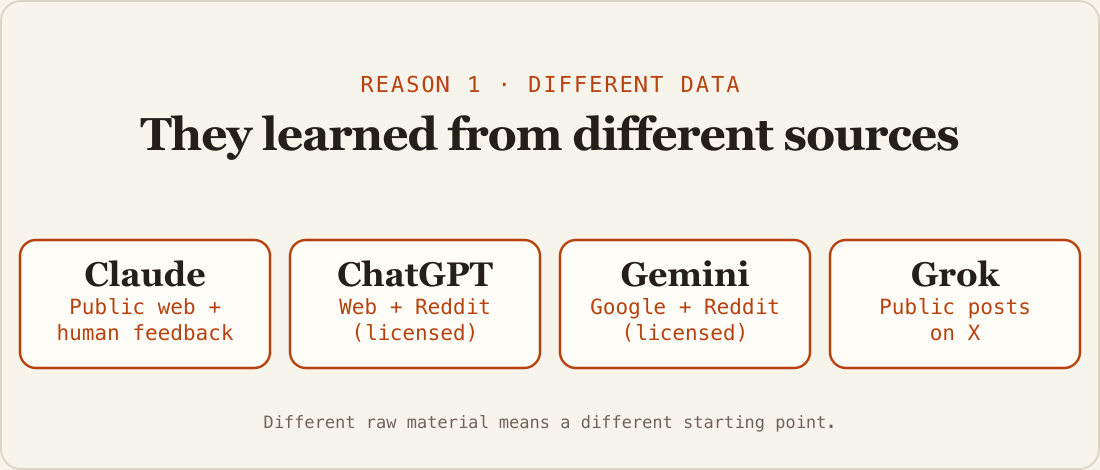
"Licensed Reddit content" is not the same as "trained only on Reddit." Reddit is one slice of a huge training set. But the deals are real, and they mean two of the four have paid access to a large opinion forum that the other two do not.
A licensing deal is also not the same as a citation, and the citation side moves fast. Promptwatch, which tracks the sources behind AI answers, logged ChatGPT's Reddit share falling from 3.8 percent to under 1 percent on August 14, 2026, then averaging 0.5 percent from August 14 to 17. Google's AI answer features, part of the wider AI-search landscape rather than something Saidly checks, slid more gently over the same weeks. Promptwatch says a data-collection issue cannot be ruled out and calls the size of the drop provisional, which is worth carrying along with the number. The point survives the caveat: what a model was trained on and what it points at this week are two different things, and the second one can change in a day.
Reason 2: they don't search the same web
Modern models don't only lean on training. When they look something up live, each one uses a different search engine underneath. Claude's web search reportedly runs on Brave. ChatGPT's search uses Bing's index plus licensed news partners. Gemini uses Google Search. Grok reads posts on X plus the general web. Point four different search engines at the same question and they surface different pages, so the four models end up reading different evidence about you.
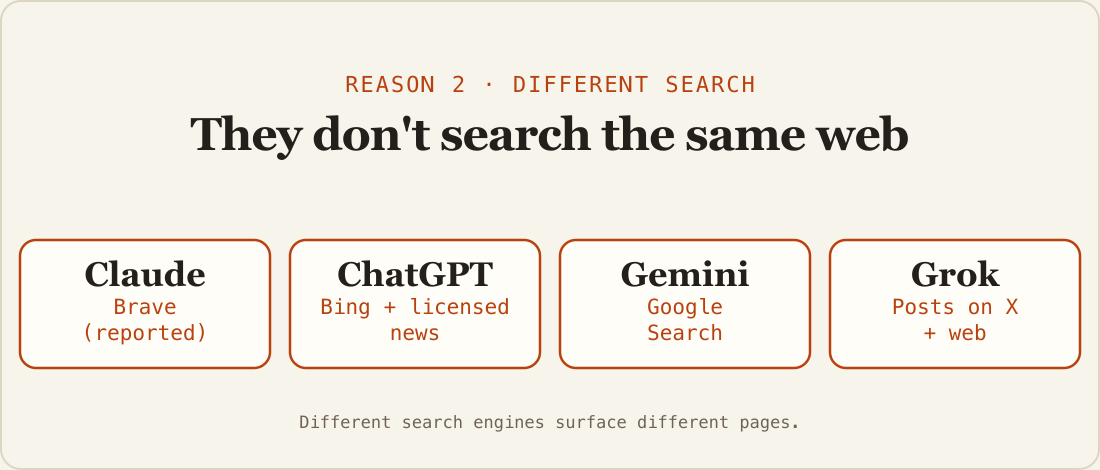
We write "reportedly" for Claude and Brave deliberately. Anthropic has not made it an official headline, though its documentation and outside reporting point to Brave. When we are not certain, we say so rather than dress it up as confirmed.
Reason 3: they are tuned with different rules
After training, each company shapes how its model behaves. Anthropic uses what it calls Constitutional AI: the model checks its own answers against a written set of principles. OpenAI uses human feedback plus a public "model spec" that spells out intended behavior. Google and xAI use their own guidelines. Different rules change tone, how willing a model is to speculate, and how it frames a subject, so the same facts can come out sounding different.
Reason 4: they were trained at different times
Each model has a knowledge cutoff, the point where its training data ends, and those dates differ. They also move every few months as new versions ship, which is why we are not printing exact dates here. The four were not trained on the same day, so one may know about your recent launch or rebrand and another may not.
Reason 5: a bit of randomness is built in
Even a single model is not perfectly repeatable. Ask it the same question twice and you can get two different answers, partly by design (there is randomness in how it picks each word) and partly because live web results keep changing hour to hour. Multiply that by four models and you can see why "what AI says about us" is never one fixed number.
What this means for your brand
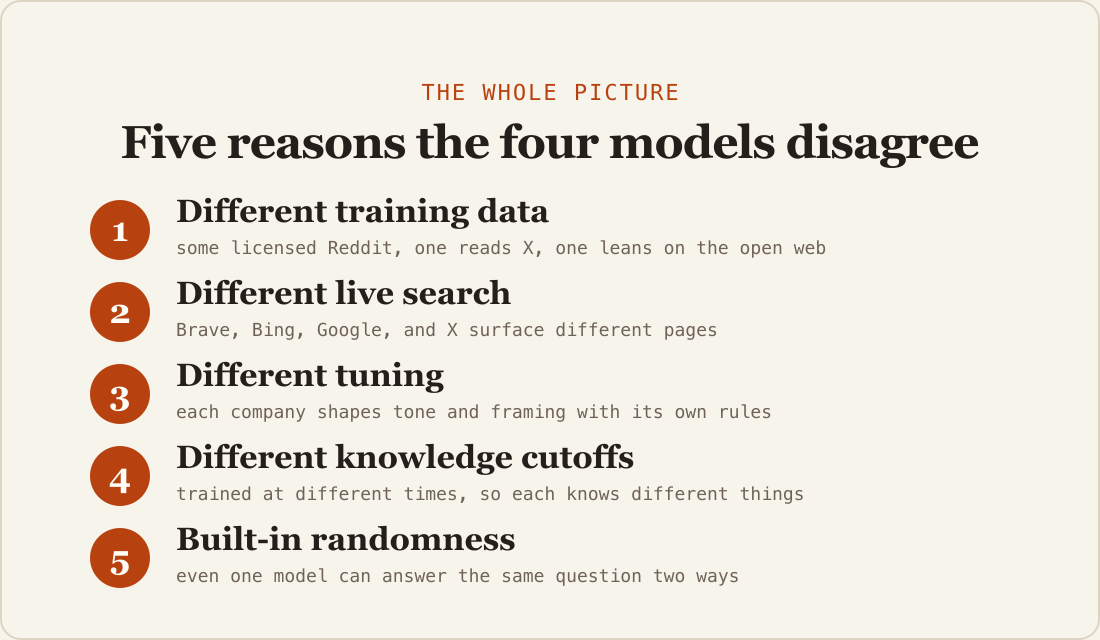
Put the five together and there is no single answer about what AI says about you. There are at least four, they disagree, and they shift week to week. Checking one model tells you roughly a quarter of the story, so the first step is to measure all four and watch them over time. That is the whole idea behind AI visibility monitoring: know where you stand before your buyers do. If you are newer to the terms, our GEO vs AEO explainer and glossary cover the language.
Saidly checks Claude, ChatGPT, Gemini, and Grok on a schedule, scores what each one says about your company, product, or name, and shows you the sources behind every answer. If you want to start small, the free check reads one model in seconds, no signup. For the full picture across all four, the 30-day trial is the same engine, no card required.
Sources
- Google and Reddit content-licensing deal, reported at about 60 million dollars a year (February 2024): CBS News; Reuters via Search Engine Land.
- OpenAI and Reddit licensing deal (May 2024): TechCrunch; The Hollywood Reporter. Framed as licensing Reddit content; financial terms not officially disclosed.
- Grok trains on and reads public posts on X: xAI (x.ai); X Help Center.
- Claude training data (publicly available web data, licensed data, and human feedback): Anthropic Claude 4 System Card.
- Live-search backends: Claude reportedly uses Brave (TechCrunch, March 2025, reported, not officially confirmed); ChatGPT Search uses Bing's index plus licensed publishers (OpenAI); Gemini uses Google Search grounding (Google); Grok uses posts on X plus web (xAI).
- Alignment methods: Anthropic Constitutional AI; OpenAI RLHF and its public Model Spec.
- Reddit citation share in ChatGPT and in Google's AI answer features, tracked July 7 to August 17, 2026: Reddit citations are dropping in ChatGPT (Promptwatch, Klaas Foppen, August 18, 2026). Promptwatch's own note: a data-collection issue cannot be ruled out, so the size of the drop is provisional.
- Non-determinism (same prompt, different answers): "Non-Determinism of Deterministic LLM Settings" (arXiv).