AI visibility
Why AI cites your site but never names your brand
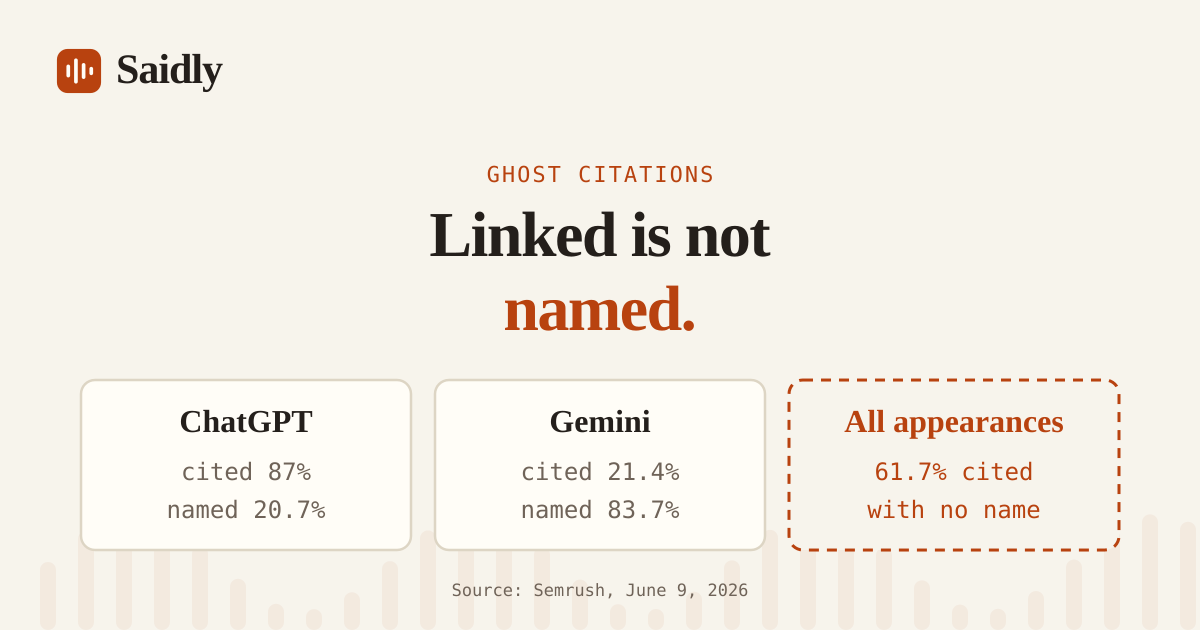
An AI answer can link to your site and never say your name. Semrush studied this in 2026 and found it is the most common outcome: of 3,981 domain appearances across four AI search experiences, 61.7% were cited as a source without the brand being named in the answer. If you track AI visibility by counting links, you are counting something the answer text may never mention.
What is a ghost citation?
Two things can happen to a brand in an AI answer. The answer can link to your page, which Semrush calls a citation. Or the answer text can write your brand name, which it calls a mention. They are separate events. A page can be cited while a competitor is the brand the answer recommends, and a brand can be named with no link at all.
Semrush calls a citation without a mention a ghost citation: the source is linked, but the answer text never names the brand.
Does every AI engine do this the same way?
No. ChatGPT and Gemini sit at opposite ends. In the Semrush data, ChatGPT linked a domain 87% of the time it appeared but wrote the brand name only 20.7% of the time. Gemini ran the other way: it named the brand 83.7% of the time and linked it 21.4%. Google's AI Overviews sat in the middle, leaning toward links, and AI Mode named brands nearly twice as often as ChatGPT. Semrush did not publish exact figures for those two.
The engines also disagreed with each other. On 100 of the 454 prompt and domain combinations the study compared, they split on whether to name the brand. It is the same pattern we describe in why the four models disagree about you: a good result in one assistant says little about the others.
The study tested ChatGPT, Google AI Overviews, Gemini and Google AI Mode. It did not test Claude or Grok, so these figures say nothing about how often they leave a brand unnamed.
What makes an answer name a brand?
Prompt length produced the widest gap. Short, conversational prompts were mentioned at rates near 100%. Long, structured prompts were mentioned 2% to 3% of the time. Comparison and how-to questions named brands more often (43.3% and 42.8%) than informational ones, where 89.3% of appearances were citations and only 18% were mentions. Country mattered too: India and Sweden reached 50%, while Italy, Brazil and the Netherlands sat between 18% and 22%.
So a brand that shows up when a buyer types "best project management app" may vanish when the same buyer pastes a three-paragraph brief. You only see that by asking both kinds of question.
What can you do about it?
Semrush's advice depends on what you publish. If you run a research or reference site, expect more citations than mentions and treat citations as the metric. If you sell a product, the gap is a problem. The study recommends getting unlinked mentions on third-party sites such as Reddit threads, news coverage and listicles, plus clearer brand references and comparison sections that name specific tools and companies.
- Read the answer text, not just the source list. Search the answer for your brand name, because a link in the sources does not tell you whether the answer named you.
- Ask short and long versions of the same question. The gap between 100% and 3% above is a gap in the prompt.
- Check each model on its own. Averages hide the ChatGPT and Gemini split. The free check runs one model in seconds.
- Name yourself on your own pages. Put the brand and product name next to the claims you want quoted, so a passage lifted out of context still carries them. Our guide to getting cited in AI answers covers the crawler side.
This week: on Oct. 15, Google said it is adding more inline links to AI Mode and AI Overviews and showing them higher in responses. More links raise the odds of a citation. They do not change whether the answer says your name.
Where Saidly fits
Saidly asks Claude, ChatGPT, Gemini, and Grok about the names you track, grounded on the live web, and reports what each one says, which sources it cited and which competitors it brought up beside you. The answer text and the source list sit in one report, per model, so you can see where a model links you and where it names you. The methodology page explains the scoring.
The free check reads one model in seconds with no signup. The 30-day trial covers all four, no card required.
Frequently asked questions
What is a ghost citation?
A ghost citation is an AI answer that links to your site as a source but never writes your brand name in the answer text. Semrush's study uses the term. In it, 61.7% of the domain appearances it tracked were ghost citations.
Is a citation or a mention worth more?
The study does not measure sales or clicks, so it cannot say. Semrush's advice splits by type of site: publishers and research sites should expect more citations than mentions and track citations, while consumer brands should work on getting named.
Does this happen in Claude and Grok too?
We don't know. The Semrush study covered ChatGPT, Google AI Overviews, Gemini and Google AI Mode, so it says nothing about Claude or Grok. Checking each model separately is the only way to find out for your brand.
How do I check whether AI names my brand?
Ask the questions your buyers ask and read the answers, looking for your name in the text rather than only your link in the sources. The free check reads one model in seconds with no signup.
Sources
- Semrush: Why 62% of AI citations don't lead to brand mentions. Margarita Loktionova, with Christine Skopec, Kevin Indig and Growth Memo, published June 9, 2026. A vendor study (Semrush sells AI visibility tools) with published methodology: 3,981 domain appearances, 115 prompts, 14 countries, four engines. Collection dates are not stated. The source for every figure in this post except the Google item.
- Google, The Keyword: updates to links in AI Mode and AI Overviews. Hema Budaraju, October 15, 2026. The source for the added-links change.
Google AI Overviews and AI Mode are cited as evidence about the wider AI-search field. Saidly checks Claude, ChatGPT, Gemini, and Grok.