AI visibility
How to get your site cited in AI answers
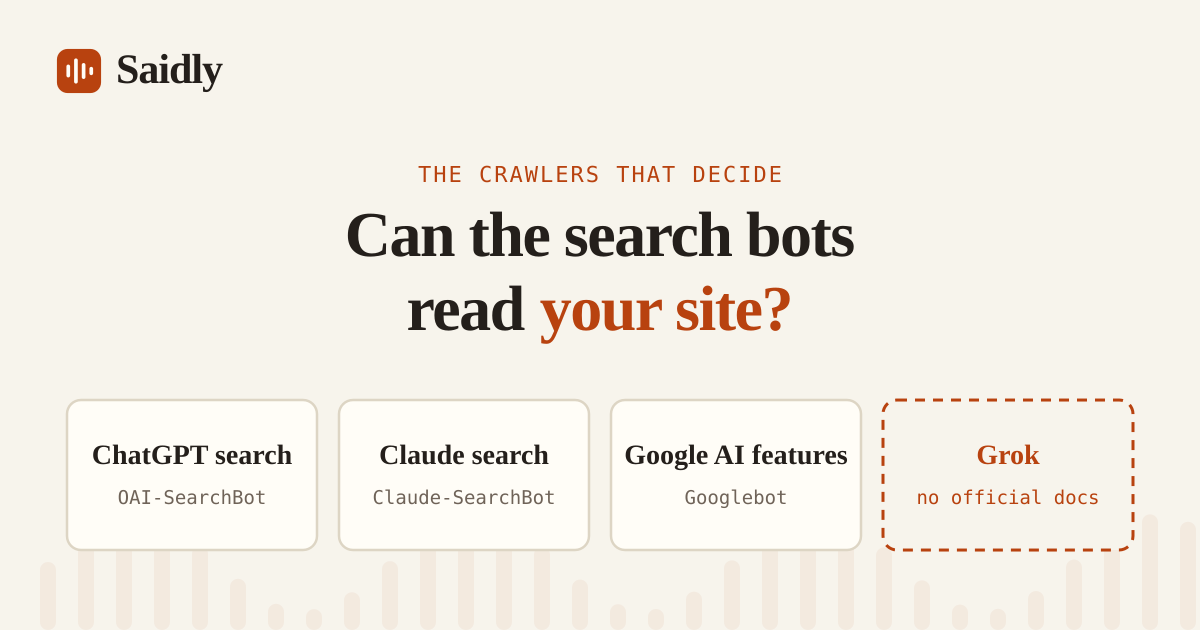
To get cited in an AI answer, the assistant's search crawler has to be allowed to read your page, and the page has to hold something worth quoting. Neither takes a special file or a trick. Here is what OpenAI, Anthropic and Google say about the first part, and what one recent study found about the second.
Step one: can the search crawler get in?
Each company runs more than one bot, and they do different jobs. Which one you block decides whether you can show up in that company's answers.
OpenAI lists three. OAI-SearchBot "is for search": it is the bot that surfaces sites in ChatGPT's search features. GPTBot collects content that may be used to train OpenAI's models, and OpenAI says blocking it does not affect search appearance. ChatGPT-User handles visits that a person starts inside ChatGPT, and because a user triggers them, robots.txt rules may not apply. A site that opts out of OAI-SearchBot "will not be shown in ChatGPT search answers," though it can still appear as a plain link. OpenAI says search-related robots.txt changes can take about 24 hours.
Anthropic splits it the same way. ClaudeBot collects content that could be used for training. Claude-User retrieves pages when a Claude user asks a question, and blocking it "may reduce your site's visibility for user-directed web search." Claude-SearchBot indexes content for search, and blocking it "may reduce your site's visibility and accuracy in user search results." Anthropic's page was last updated April 7, 2026.
Google's AI Overviews and AI Mode are part of the wider AI-search landscape, not something Saidly checks, but the rule is the same. A page has to be "indexed and eligible to be shown in Google Search with a snippet." Google adds that indexing and serving "isn't guaranteed," and that its crawling is controlled through Googlebot's robots.txt directives. If you use nosnippet, max-snippet or noindex to limit previews, those also limit what AI features can show.
For Grok, we could not find crawler documentation published by xAI. Third-party bot directories list tokens such as xAI-SearchBot, but they describe them as observed rather than documented, and sources disagree on whether the bots follow robots.txt. We are not going to tell you what to put in robots.txt for Grok, because the vendor has not said.
Do you need a special file or markup?
Google says no, at least for its own features: "There are no additional requirements to appear in AI Overviews or AI Mode, nor other special optimizations necessary," and "You don't need to create new machine readable files, AI text files, or markup to appear in these features." It points to ordinary search basics instead: allow crawling, link pages internally, keep structured data consistent with the visible text, and write helpful content for people. That page was last updated Dec. 10, 2025.
Step two: what makes a page worth quoting?
Getting crawled puts you in the pool. Being picked is a separate step, and the assistant often builds its answer from several related searches rather than one. Google describes this as "query fan-out": issuing multiple related searches across subtopics, which lets the features show a wider set of links than classic search.
One study looked at what separates pages that shape an answer from pages that are merely listed. A preprint posted to arXiv in April 2026 (Zhang Kai, He Xinyue and Yao Jingang) analyzed a public dataset of 602 controlled prompts and 21,143 citations from ChatGPT, Google's AI Overview and Gemini, and Perplexity, which Saidly does not check. It separates "citation selection," where a platform chooses sources, from "citation absorption," where a cited page actually contributes to the final answer. The pages with the most influence tended to be longer, more structured, closer in meaning to the query, and richer in extractable evidence: definitions, numerical facts, comparisons and procedural steps.
That is one preprint, and it describes what the cited pages looked like, not a recipe that guarantees a citation. It still fits the plain advice. State the answer near the top of the page, define your terms, put real numbers and dates in the text, and break procedures into steps. Our GEO vs AEO explainer covers the vocabulary if the terms are new.
Step three: read what the answer says about you
A citation is not an endorsement. An assistant can cite your page and still describe your brand in a way you would not, and the four models often disagree with each other about the same company. The reasons are laid out in why Claude, ChatGPT, Gemini, and Grok disagree about you. The only way to know is to ask. The free check reads one model in seconds with no signup, which shows how that model describes you today.
Google also lets readers pick sources they want to see more of, covered in our preferred sources guide.
Frequently asked questions
Do I need an llms.txt file or special markup to get cited?
For Google's AI features, no. Google's documentation says: "You don't need to create new machine readable files, AI text files, or markup to appear in these features." The OpenAI and Anthropic pages describe robots.txt rules for their bots, not a separate file.
Should I block GPTBot?
Blocking GPTBot does not affect whether you appear in ChatGPT search. OpenAI says GPTBot is for training data, and OAI-SearchBot is the one that controls search. Blocking GPTBot is a separate choice about training.
How long does a robots.txt change take to work?
OpenAI says search-related changes can take about 24 hours. Google says recrawling a page after you change its preview controls can take several days to several months.
If an AI cites my site, does it describe my brand well?
Not necessarily. Being cited means the page was used as a source. How the answer characterizes you, and whether Claude, ChatGPT, Gemini and Grok agree, is a separate question that you have to read for yourself.
Check what the four models say about you
Saidly checks Claude, ChatGPT, Gemini, and Grok on a schedule, scores what each one says about your company, product, or name, and shows you the sources behind every answer. The free check reads one model in seconds, no signup. For the full picture across all four, the 30-day trial is the same engine, no card required. The monitoring guide explains how it works.
Sources
- Google Search Central, "AI features and your website" (last updated Dec. 10, 2025): developers.google.com/search/docs/appearance/ai-features.
- OpenAI, "Overview of OpenAI crawlers" (no update date shown on the page, read Oct. 11, 2026): developers.openai.com/api/docs/bots.
- Anthropic, "Does Anthropic crawl data from the web, and how can site owners block the crawler?" (updated April 7, 2026): support.claude.com.
- Zhang Kai, He Xinyue and Yao Jingang, "From Citation Selection to Citation Absorption: A Measurement Framework for Generative Engine Optimization Across AI Search Platforms" (arXiv:2604.25707, April 2026, preprint): arxiv.org/abs/2604.25707.
- xAI crawler documentation: none found from xAI. Third-party bot directories (such as Known Agents and Botcrawl) list unverified tokens.