AI visibility
Does schema markup help AI cite your site?
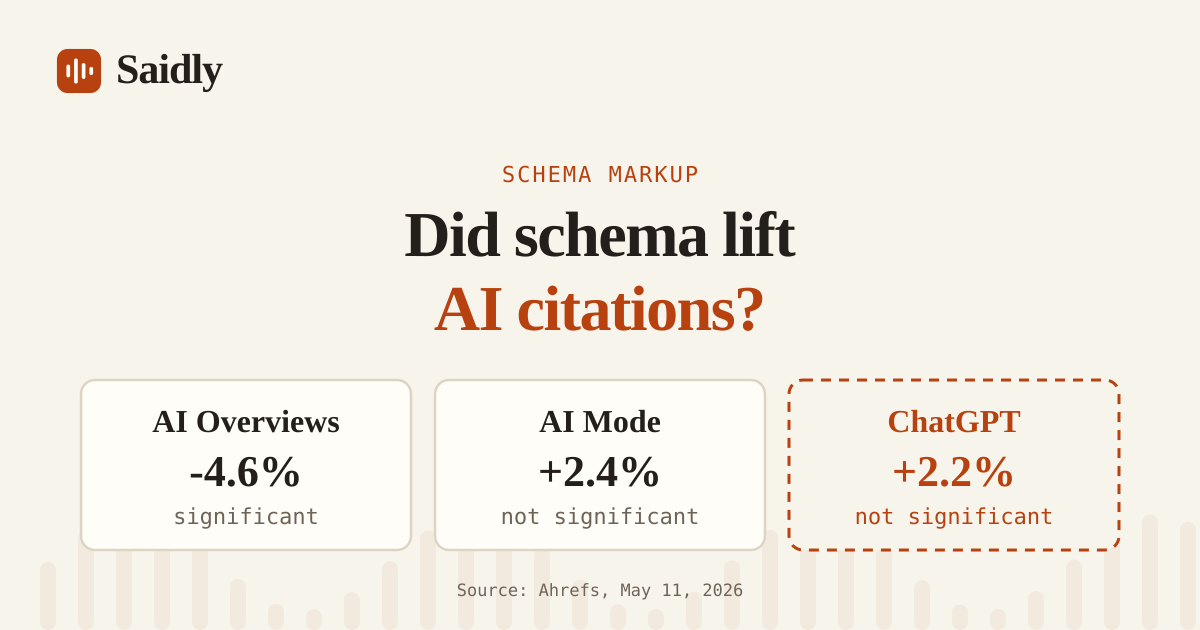
Probably not. Ahrefs followed 1,885 pages that added JSON-LD schema between August 2025 and March 2026 and compared them with 4,000 matched pages that did not. Citations in Google AI Overviews, Google AI Mode and ChatGPT showed no clear lift. Google's own documentation says no special schema is needed for its AI features.
What did the Ahrefs study test?
Ahrefs started from a correlation. In an earlier analysis of 6 million URLs, pages cited by AI were almost three times as likely to have JSON-LD schema as pages that were not. That could mean schema helps, or it could mean well-run sites tend to add schema and also get cited. So Ahrefs ran a second study to test the cause.
It took 1,885 pages that added JSON-LD during that eight-month window and matched them against 4,000 pages from other domains with similar citation levels that never added it. For each page it counted citations in the 30 days before and the 30 days after the change. Every page had at least 100 Google AI Overview citations in February 2025, so these were pages AI answers already cited often.
What did it find?
Google AI Mode came out at +2.4% and ChatGPT at +2.2%. Ahrefs says neither is distinguishable from zero. AI Mode citations rose 43% on a raw before-and-after count, but Ahrefs says that mostly reflected a platform-wide boom that control pages saw too. The authors summarize the result as "not much really changed."
Ahrefs calls the AI Overview drop real but unexplained. Both groups were already declining before the change, and the authors list possible causes other than schema: a Google update, stale content, or Google not recrawling the page.
What are the limits of the study?
Ahrefs lists them. Only pages that were already heavily cited were tested, so schema's effect on pages with no citations is unknown. Schema changes often shipped with other edits, such as new links or content fixes. All schema types were pooled, the window was 30 days, and only JSON-LD was tested, not Microdata, RDFa or schema injected by JavaScript. Two more caveats are ours, not Ahrefs': the study measured only AI Overviews, AI Mode and ChatGPT, not Claude, Grok or the Gemini app, and Ahrefs sells SEO tools, so this is a vendor study, though its methodology is published.
What does Google say?
Google's documentation on AI features says: "There's also no special schema.org structured data that you need to add," and "You don't need to create new machine readable files, AI text files, or markup to appear in these features." It still tells site owners to make sure structured data matches the visible text on the page. The page was last updated Dec. 10, 2025. Our guide to getting cited in AI answers covers the crawler and content side.
Should you still add schema?
Yes, for the jobs it was built for. Ahrefs still recommends it for rich results, voice assistants, knowledge graphs and entity recognition, and says that for pages already visible to AI its data does not support the bet that schema raises citations. Keep the schema you have, and don't count on it for citations.
If you want to know whether it works for your pages, Ahrefs suggests a small test: add it to some pages, leave similar ones alone, and compare. Before changing any markup, read what AI already says about you. The free check shows one model's answer.
Where Saidly fits
Saidly asks Claude, ChatGPT, Gemini, and Grok about the names you track, grounded on the live web, and reports what each says, which sources it cited and which competitors it named beside you. When you change something on your site, the next report shows what the answers say now. The four models often disagree; here is why.
The free check reads one model in seconds with no signup. The 30-day trial covers all four, no card required.
Frequently asked questions
Does schema markup help ChatGPT cite my site?
In the Ahrefs study, pages that added schema saw ChatGPT citations rise 2.2% against matched control pages, and Ahrefs says that is indistinguishable from zero. The study only covered pages that already had heavy AI citations, so it does not say what happens to pages with none.
Should I remove my schema markup?
No. The study found no clear effect in either direction, and Ahrefs still recommends schema for rich results, voice assistants, knowledge graphs and entity recognition. Google also says to keep structured data consistent with the visible text on the page.
Why did earlier research say cited pages have more schema?
Ahrefs' first analysis of 6 million URLs found AI-cited pages were almost three times as likely to have JSON-LD as non-cited pages. That is a correlation. When Ahrefs followed pages that added schema and compared them with matched pages that did not, the lift did not appear.
How do I check whether AI names my brand?
Ask the questions your buyers ask and read the answers for your name, not just a link. The free check reads one model in seconds with no signup.
Sources
- Ahrefs: We Tracked 1,885 Pages Adding Schema. AI Citations Barely Moved. Louise Linehan, with Xibeijia Guan, reviewed by Ryan Law, published May 11, 2026. A vendor study with published methodology: 1,885 treated pages, 4,000 matched control pages, 30-day windows. The source for every figure in this post.
- Google Search Central: AI features and your website. Last updated Dec. 10, 2025. The source for the Google quotes.
- Search Engine Roundtable: Study Says Adding Schema Did Not Improve AI Citations. Barry Schwartz, May 13, 2026. Secondary coverage of the Ahrefs study.
Google AI Overviews and AI Mode are cited as evidence about the wider AI-search field. Saidly checks Claude, ChatGPT, Gemini, and Grok.