AI visibility
Can you block AI training and still appear in AI answers?
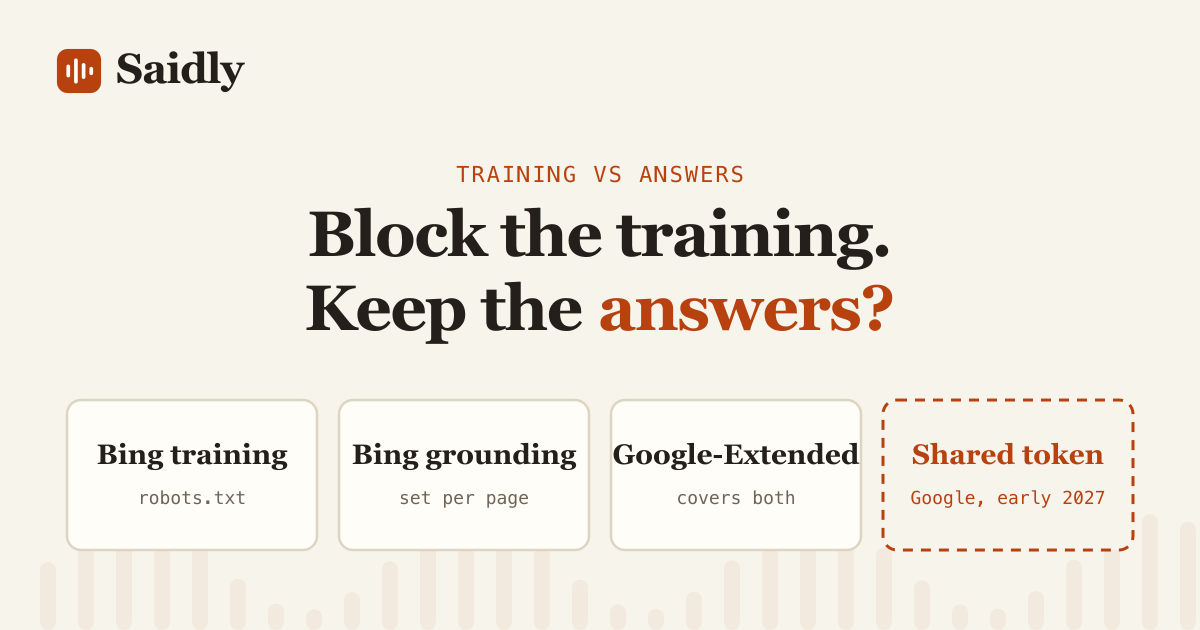
On Bing, yes: Microsoft announced on Oct. 30, 2026, that site owners can opt out of AI training and AI grounding separately and still appear in Bing search results. On Google, no. One token, Google-Extended, covers both Gemini training and grounding in Gemini Apps, so blocking training there also takes your pages out of Gemini's answers. Google announced the same day that it will support a shared training control in robots.txt in 2027, and it will read that control the same way.
What is the difference between training and grounding?
Training means a company uses your pages to teach a model. Grounding means a model reads your pages at answer time to help write a response, usually with a link. Microsoft defines its grounding preference as allowing or preventing your content from helping to generate AI answers. On Bing, blocking one does not block the other. On Google, one token covers both.
One example: a publisher blocks model training but still lets Copilot cite its articles. Bing's older NoArchive and NoCache directives, Microsoft says, will stop being read as a training or grounding preference after March 1, 2027.
What did Bing change?
Bing now has two independent preferences, both defaulting to Allow when you publish nothing, according to Microsoft's announcement by Krishna Madhavan.
- AI Training can be set to Disallow in robots.txt for the whole site or a path, using
User-Agent: __usage_ai-trainingfollowed by aDisallowline. A page-level setting overrides robots.txt. - AI Grounding is page-level only, with no site-wide robots.txt setting. Disallow keeps the page out of generated answers. DisallowExtended limits it to Microsoft's own experiences such as Copilot and Microsoft 365, and excludes third-party grounding services.
At page level, training uses <meta name="Bingbot" content="ai-training:disallow"> and grounding uses <meta name="Bingbot" content="ai-grounding:disallow">, or ai-grounding:disallowextended for the Microsoft-only option. The header form is X-Robots-Tag: Bingbot: ai-grounding:disallow. Microsoft says these settings govern use of content, not crawl access, and do not change eligibility for traditional Bing search results. An Allow setting does not override a robots.txt rule that blocks Bingbot, and a new setting takes effect only after Bing recrawls the page. Microsoft also warns that blocking grounding can reduce your visibility in AI experiences.
What is Google doing?
Google says it plans to support a draft IETF proposal from the AIPREF working group: one training preference in robots.txt that applies across participating AI providers. Google's crawler documentation says it intends to support the user-agent: __usage_ai-training signal in early 2027. Google's announcement, posted by John Mueller, says that when a site opts out with this token and does not name Google-Extended, Google will treat it as if the site had disallowed Google-Extended. An explicit Google-Extended rule takes precedence.
Google-Extended already exists. Google's documentation says it is a standalone product token, has no separate HTTP user agent string, and does not affect inclusion in Google Search or act as a ranking signal. The same documentation says Google-Extended also controls whether that content is used for grounding in Gemini Apps and in Grounding with Google Search on Vertex AI. So on Google, disallowing Google-Extended to stop training also takes your pages out of Gemini Apps grounding. Google's announcement says sites that allow Google-Extended are eligible to appear in Gemini Apps responses and receive clicks via grounding. Google's documentation does not say how Google-Extended relates to AI Overviews or AI Mode.
The proposal is still a draft. Search Engine Roundtable cites Nate Hake, who takes part in the process, saying significant disputes remain, including over exempting user-initiated actions. Only the training definition is being adopted now.
What should you set?
Decide the two questions separately. Do you want your content used to train models? Do you want pages available to inform answers about you? Most brands that want to be named in answers will want grounding allowed, since a blocked page cannot inform one.
- Check your robots.txt for blanket rules written before these controls existed. Our guide to getting cited in AI answers explains which crawlers control search and which control training.
- On Google, you cannot block Gemini training while keeping Gemini Apps grounding. If being named in Gemini matters to you, leave Google-Extended allowed, and remember the shared training token will count as a Google-Extended disallow unless you name Google-Extended explicitly.
- If you use NoArchive or NoCache on Bing, publish page-level grounding preferences and record a temporary grounding preference in Bing Webmaster Tools (available Dec. 15, 2026) before March 1, 2027.
- Do not rely on the shared Google signal before 2027, and do not treat the draft as final.
- After any change, read what the models say. A permission lets your pages in. It does not tell you what an answer says about you, and the four models often disagree.
Where Saidly fits
Saidly asks Claude, ChatGPT, Gemini, and Grok about the names you track, grounded on the live web, and reports what each says, which sources it cited and which competitors appeared beside you. It cannot see your robots.txt choices, but it shows the outcome in the answers. See the methodology page.
The free check reads one model in seconds with no signup. The 30-day trial covers all four, no card required.
Frequently asked questions
Does blocking AI training remove me from AI answers?
On Bing, no. Microsoft says you can opt out of training and grounding separately and stay eligible for Bing search results. On Google, partly. Google-Extended does not affect inclusion in Google Search, but it covers both Gemini training and grounding in Gemini Apps, so disallowing it removes you from both.
What is the __usage_ai-training token?
It is the user-agent name in the shared AI training preference being drafted at the IETF. Bing documents it now and starts honoring it on Feb. 1, 2027. Google says it intends to support it in early 2027 and will treat it as a Google-Extended disallow, which also removes Gemini Apps grounding.
Do these controls cover ChatGPT, Claude and Grok?
Not directly. Microsoft's and Google's controls cover their own products. Search Engine Roundtable reports that OpenAI and Anthropic have announced plans to adopt the IETF proposal; we did not confirm that with either company. Our guide to getting cited covers the OpenAI and Anthropic crawlers.
If I allow grounding, will AI describe my brand well?
Not necessarily. Allowing grounding lets your pages inform answers. What each answer says about you, and whether Claude, ChatGPT, Gemini and Grok agree, is a separate question you have to read for yourself.
Sources
- Microsoft Bing Blog: Your content, your choice: clearer preferences for training and grounding. Krishna Madhavan, Oct. 30, 2026. Primary source for the Bing settings, syntax and dates.
- Google Search Central: Common crawlers (Google-Extended). Google documentation, read November 1, 2026. Source for what Google-Extended covers and the early 2027 plan.
- Google Search Central Blog: Supporting a shared AI training control for websites. John Mueller, Oct. 30, 2026. Primary source for the Google plan.
- Search Engine Roundtable: Google Adopts New AI Training Control. Oct. 30, 2026. Source for the Nate Hake statements.
- Search Engine Roundtable: Microsoft Bing New AI Controls. Oct. 30, 2026. Secondary report of the Bing announcement.
Bing, Copilot and Google's AI features are cited as evidence about the wider AI-search field. Saidly checks Claude, ChatGPT, Gemini, and Grok.